

In a digital era obsessed with artificial intelligence, cloud computing, and quantum breakthroughs, one decades-old technology is quietly making headlines again: NS Mainframe. Once viewed as a relic of enterprise IT, mainframe systems are now central to discussions about cybersecurity, financial resilience, government modernization, and AI integration.
The renewed interest is not nostalgia. Banks still process billions of transactions daily on mainframes. Airlines rely on them for reservations. Governments use them for tax, defense, and social services systems. As organizations confront rising cyber threats and the limits of fragmented cloud architectures, the conversation around NS Mainframe has shifted from “Why keep it?” to “How do we modernize it?”
The resurgence of NS Mainframe in 2026
The biggest surprise in enterprise technology this year is not a brand-new platform. It is the realization that mainframes never left. Analysts at Gartner and IDC continue to report that a majority of the world’s core banking and transaction-processing workloads still run on mainframe environments. What changed is perception.
Over the past 18 months, several high-profile outages in distributed cloud systems exposed the fragility of overly decentralized architectures. In contrast, modern mainframes demonstrated exceptional uptime, transaction integrity, and security. That reliability has pushed NS Mainframe into boardroom conversations across finance, healthcare, telecom, and public-sector organizations.
Another factor driving attention is AI readiness. Enterprises rushing to deploy generative AI discovered that their most valuable structured data often lives on mainframes. Rather than migrating everything to the cloud, many organizations are now integrating AI tools directly with mainframe environments, creating hybrid architectures that combine stability with innovation.
Why enterprises still trust mainframes
Mainframes earned their reputation through consistency. Unlike many distributed systems, they are designed to handle massive transaction volumes with near-perfect reliability. A single modern mainframe can process millions of secure transactions per second while maintaining strict data integrity.
For industries where downtime equals financial catastrophe, that matters enormously. Consider global banking: payment clearing, ATM networks, fraud detection, and account management often depend on mainframe infrastructure. Airlines and railway systems also rely on these platforms because reservation systems must operate continuously across time zones and peak demand periods.
Security is another major advantage. Mainframes were built for environments where data protection was non-negotiable. Their architecture emphasizes centralized control, granular access management, and strong auditability. In an age of ransomware and supply-chain attacks, those characteristics have regained strategic importance.
The modernization wave transforming NS Mainframe
The old image of green-screen terminals and isolated systems is increasingly outdated. Today’s NS Mainframe environments are undergoing aggressive modernization. Enterprises are exposing mainframe functions through APIs, connecting them to cloud-native applications, and integrating DevOps pipelines.
This transformation is creating a new category often described as the hybrid mainframe. Instead of replacing legacy systems entirely, organizations are extending them. Critical transaction engines remain on the mainframe, while customer-facing apps, analytics dashboards, and AI services run in cloud environments.
IBM’s z16 platform, launched with AI acceleration capabilities, accelerated this trend. Other enterprise vendors and system integrators have followed with tools designed to connect COBOL-based systems to modern programming frameworks such as Java, Python, and containerized microservices.
The result is a quieter but more practical revolution: modernization without disruption. For many enterprises, that is far cheaper and less risky than full migration projects that can take years and exceed budgets.
How AI is changing the mainframe conversation
Artificial intelligence has unexpectedly become one of the strongest arguments for keeping mainframes. Large language models and predictive analytics systems need clean, structured, high-volume data. Mainframes contain exactly that: decades of transactional history, customer records, and operational data.
Instead of extracting all data into external warehouses, companies are increasingly deploying AI closer to where the data resides. This reduces latency, improves governance, and limits the security risks associated with massive data transfers.
There is also growing interest in using AI to modernize mainframe code itself. Tools powered by generative AI can analyze COBOL applications, generate documentation, identify vulnerabilities, and assist developers in translating or refactoring legacy code. That could help address one of the industry’s biggest concerns: the shrinking pool of experienced mainframe programmers.
The cybersecurity angle no one can ignore
Cybersecurity may be the single most important reason NS Mainframe is trending in news and policy discussions. Governments and financial regulators are increasingly focused on operational resilience — the ability to keep critical systems running during cyberattacks, outages, or geopolitical disruptions.
Mainframes offer advantages in this environment. Their centralized architecture reduces the attack surface compared with sprawling multi-cloud ecosystems. They also support advanced encryption, secure partitioning, and highly controlled administrative access.
That does not mean they are invulnerable. Legacy applications can still contain weaknesses, and organizations must modernize security practices continuously. But compared with many distributed environments, mainframes often provide stronger baseline control and visibility.
Recent ransomware incidents affecting hospitals, logistics firms, and municipal systems have reinforced a broader lesson: resilience matters as much as innovation. For mission-critical operations, reliability is no longer seen as boring infrastructure. It is strategic defense.
The talent challenge facing the industry
Despite renewed interest, the mainframe ecosystem faces a serious workforce problem. Many experienced COBOL and z/OS professionals are nearing retirement, while younger developers often gravitate toward cloud-native technologies.
This talent gap has become a major business issue. Some organizations struggle to maintain legacy applications because only a handful of employees understand the systems deeply. In response, universities, training programs, and enterprise vendors are investing in new education initiatives focused on mainframe development and modernization.
Interestingly, the narrative is beginning to shift among younger engineers. As salaries rise and demand increases, mainframe expertise is becoming a lucrative niche rather than a dead-end specialty. Developers who understand both cloud technologies and NS Mainframe environments are especially valuable because hybrid architectures are becoming the norm.
Economic realities behind mainframe decisions
One reason organizations do not simply abandon mainframes is cost. Replacing a deeply integrated enterprise system is extraordinarily expensive. Failed migration projects have cost companies hundreds of millions of dollars and, in some cases, disrupted customer services for months.
Executives increasingly evaluate modernization through a pragmatic lens: What delivers the best business outcome with the least operational risk? Often, the answer is not “rip and replace.” It is incremental modernization.
Mainframes also remain highly efficient for certain workloads. A single system can consolidate workloads that might otherwise require large fleets of distributed servers, reducing energy, licensing, and operational complexity in some scenarios.
That economic calculation helps explain why analysts predict continued investment in mainframe technology through the late 2020s, particularly in regulated industries.
NS Mainframe and the future of hybrid enterprise IT
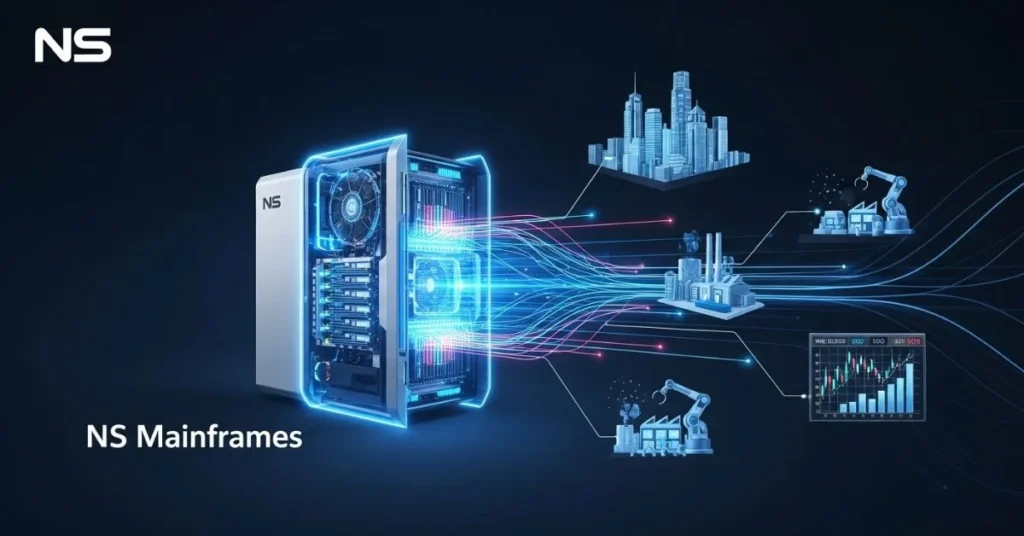
The future is unlikely to be purely mainframe or purely cloud. Enterprise IT is moving toward hybrid architecture: a mix of on-premises systems, private clouds, public clouds, edge computing, and AI platforms working together.
In that landscape, NS Mainframe becomes less of a standalone system and more of a high-performance core within a broader ecosystem. APIs, containers, event streaming, and AI orchestration layers allow organizations to connect legacy strengths with modern capabilities.
This hybrid model also aligns with regulatory and sovereignty concerns. Many governments and financial institutions want the flexibility of cloud services without surrendering control over sensitive national or customer data. Mainframes provide a stable anchor for those requirements.
What businesses should do next
For organizations evaluating their infrastructure strategy, the key question is no longer whether mainframes are obsolete. The better question is: Which workloads truly benefit from migration, and which are best modernized in place?
Practical steps include:
- Audit critical workloads to identify systems that require extreme reliability, security, and transaction integrity.
- Assess integration readiness by exposing mainframe functions through APIs and modern interfaces.
- Invest in skills development for both existing staff and new hires to reduce dependency on a shrinking talent pool.
- Adopt hybrid cloud strategies that balance agility with operational resilience.
- Explore AI-assisted modernization tools to accelerate documentation, testing, and code transformation efforts.
Organizations that approach modernization incrementally often achieve better outcomes than those pursuing massive all-at-once migrations.
Key Takeaways
- NS Mainframe is experiencing a major resurgence due to reliability, cybersecurity, and AI integration needs.
- Mainframes still power critical global systems in banking, government, transportation, and healthcare.
- Modernization is replacing the “legacy vs. cloud” debate with hybrid architecture strategies.
- AI is increasing the value of mainframe data and enabling new tools for code modernization.
- Cyber resilience and operational continuity are making mainframes strategically important again.
- The industry faces a talent shortage, but demand for hybrid mainframe-cloud expertise is growing.
- Incremental modernization is often more cost-effective than full system replacement.
FAQ: NS Mainframe
What is NS Mainframe?
NS Mainframe refers to enterprise-grade mainframe computing environments used for large-scale transaction processing, data management, and mission-critical operations. These systems are known for high reliability, security, and scalability.
Why are mainframes still important today?
Mainframes remain essential because they handle enormous volumes of secure transactions with exceptional uptime. Industries such as banking, airlines, healthcare, and government depend on them for core operations.
Is NS Mainframe being replaced by cloud computing?
Not entirely. Many organizations are adopting hybrid models that combine mainframes with cloud services. Critical workloads often remain on mainframes, while newer applications and analytics run in cloud environments.
How does AI relate to mainframes?
AI systems need large, structured datasets, and mainframes store decades of valuable enterprise data. Companies are increasingly integrating AI tools directly with mainframe environments to improve analytics, fraud detection, and operational efficiency.
Are mainframes secure against cyberattacks?
Mainframes are considered highly secure due to centralized control, strong encryption, and robust access management. However, they still require modern security practices, regular updates, and vulnerability management.
What programming languages are used on mainframes?
COBOL remains widely used, but modern mainframe environments also support Java, Python, and other contemporary languages. API-based integration allows mainframes to work with modern software ecosystems.
What is the future of NS Mainframe?
The future is likely hybrid and AI-enabled. Mainframes will continue serving as reliable transaction cores while integrating with cloud platforms, AI services, and modern application architectures.
Conclusion
The story of NS Mainframe is no longer about outdated technology surviving by inertia. It is about a mature computing platform adapting to a new era of AI, cybersecurity, and hybrid enterprise infrastructure. While flashy innovations dominate headlines, the systems quietly running the world’s financial, governmental, and transportation networks are proving remarkably resilient.
For businesses, policymakers, and technologists, the lesson is clear: modernization does not always mean replacement. Sometimes the smartest strategy is to evolve proven systems into the backbone of the next generation of digital infrastructure.
