
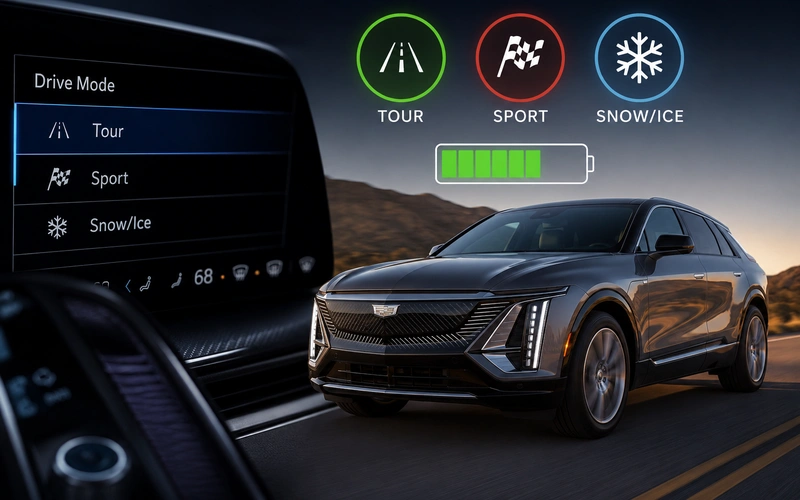
If you’ve ever switched between Tour, Sport, Snow/Ice, or My Mode in a Cadillac Lyriq, you’ve probably wondered whether those settings actually change how far the electric SUV can travel. It’s a question that continues to trend among EV owners as more drivers try to maximize every mile from their battery. While the dashboard may not show dramatic differences immediately, the impact of driving modes is more interesting than many people expect.
The growing popularity of electric vehicles has made efficiency one of the biggest talking points among drivers. As charging infrastructure expands and EV technology evolves, people are becoming increasingly curious about the small features that can influence battery performance. One question continues to surface across online forums and owner communities: do the driving modes in Cadillac Lyriq offer different ranges or battery usages? The answer isn’t as simple as yes or no, because driving modes affect several vehicle systems that indirectly influence energy consumption.
Do the Driving Modes in Cadillac Lyriq Offer Different Ranges or Battery Usages?
The simple answer is yes—but not in the way many people imagine. The Cadillac Lyriq’s driving modes do not unlock hidden battery capacity or instantly add dozens of extra miles. Instead, they modify the vehicle’s response to accelerator input, steering feel, regenerative braking characteristics, traction control, and power delivery. These adjustments influence how efficiently electricity is used during different driving conditions.
When drivers ask, do the driving modes in Cadillac Lyriq offer different ranges or battery usages?, they’re really asking whether selecting a different mode changes overall efficiency. In practical terms, it certainly can. Aggressive acceleration in Sport Mode typically consumes more energy than smoother driving in Tour Mode. Likewise, driving in Snow/Ice Mode prioritizes traction over rapid acceleration, which may improve efficiency under slippery conditions by preventing unnecessary wheel spin.
Understanding the Cadillac Lyriq Driving Modes
Cadillac designed the Lyriq to adapt to multiple road conditions without overwhelming drivers with complicated settings. Instead of changing the battery itself, each mode changes how the vehicle behaves in real-world situations.
Tour Mode serves as the everyday default. It delivers balanced acceleration, comfortable steering, and predictable energy usage. Most owners spend the majority of their driving time in this setting because it offers an ideal combination of performance and efficiency for commuting, highway travel, and city driving.
Sport Mode sharpens throttle response and provides quicker acceleration. Steering becomes firmer, making the SUV feel more responsive on winding roads. However, the quicker power delivery often encourages drivers to accelerate harder, naturally increasing battery consumption over time.
Snow/Ice Mode reduces wheel spin by delivering power more gradually. Instead of maximizing speed, it focuses on maintaining stability when roads become slippery. This smoother power delivery can sometimes reduce unnecessary energy waste during winter driving, although cold temperatures themselves remain the biggest factor affecting EV range.
My Mode allows drivers to personalize steering feel, acceleration response, and other driving characteristics. Rather than being a fixed efficiency setting, it lets owners create a balance between comfort and performance according to personal preferences.
How Driving Modes Affect Battery Usage
Battery usage depends less on the selected mode itself and more on how that mode influences driver behavior. Electric motors deliver instant torque, making rapid acceleration extremely tempting. Every hard launch demands significantly more energy than gradual acceleration.
Tour Mode naturally encourages smoother driving habits. Since throttle response is less aggressive, many drivers unknowingly accelerate more gently. That translates into lower energy consumption across longer trips. For commuters covering dozens of miles every day, these small savings gradually become noticeable.
Sport Mode tells a different story. Although it doesn’t permanently reduce battery efficiency, its sharper throttle mapping makes spirited driving easier. Frequent bursts of acceleration, rapid lane changes, and higher average speeds all require additional electrical power. Over hundreds of miles, those habits can noticeably reduce driving range.
Regenerative Braking Plays a Bigger Role Than Most Drivers Think
One of the most overlooked features influencing range is regenerative braking. Rather than wasting kinetic energy as heat, regenerative braking converts slowing motion back into electricity stored inside the battery.
Cadillac Lyriq includes adjustable regenerative braking, including One-Pedal Driving. Drivers who master this feature often recover meaningful amounts of energy during city driving. Heavy traffic, stoplights, and downhill roads become opportunities to recharge the battery slightly instead of simply consuming power.
Regardless of the selected driving mode, maximizing regenerative braking usually has a greater impact on efficiency than switching between Tour and Sport. Many experienced EV owners report improved overall efficiency after adapting their driving style rather than changing modes.
Real-World Range Depends on More Than Driving Modes
Many new EV buyers expect driving mode selection to dramatically change range figures. In reality, several other variables have a much greater influence on battery performance.
Weather remains one of the largest factors. Cold temperatures reduce battery efficiency while also increasing cabin heating demand. During winter, even the most efficient driving mode cannot completely offset these natural energy losses.
Driving speed also matters significantly. Highway travel at 75 mph consumes considerably more electricity than driving at moderate suburban speeds. Air resistance increases rapidly as speed rises, making aerodynamic drag one of the largest energy consumers for electric vehicles.
Vehicle weight further influences efficiency. Carrying passengers, cargo, roof accessories, or towing additional loads increases energy demand regardless of which driving mode is selected.
Comparing Tour Mode and Sport Mode
For many Lyriq owners, the biggest comparison comes down to Tour versus Sport. Both modes deliver excellent driving experiences, but they prioritize different goals.
Tour Mode focuses on smoothness and consistency. Acceleration remains responsive without encouraging unnecessary bursts of power. Steering feels relaxed, making long-distance driving comfortable while helping maintain predictable battery consumption.
Sport Mode transforms the personality of the vehicle. Instant acceleration becomes even more noticeable, creating a more engaging driving experience. However, drivers often enjoy using that additional responsiveness, resulting in increased energy usage over extended periods. The difference comes less from software limitations and more from human driving habits.
What EV Experts and Owners Are Saying
Across EV discussion communities, owners consistently report that driving style outweighs driving mode when it comes to maximizing range. Drivers who accelerate smoothly, anticipate traffic, and use regenerative braking effectively often achieve efficiency numbers close to or even exceeding official EPA estimates.
Automotive reviewers echo similar findings. Testing under controlled conditions generally shows only modest efficiency differences between driving modes when identical driving patterns are maintained. Once human behavior enters the equation, Sport Mode frequently results in higher battery consumption simply because drivers naturally become more aggressive behind the wheel.
This growing consensus reinforces the answer to the frequently searched question: do the driving modes in Cadillac Lyriq offer different ranges or battery usages? Yes—but mostly through their influence on driver behavior rather than direct battery management.
Tips to Maximize Cadillac Lyriq Range
Drivers looking to extract the greatest possible distance from every charge should focus on habits instead of relying solely on software settings. Smooth acceleration consistently improves efficiency, regardless of which mode is selected.
Maintaining recommended tire pressure also reduces rolling resistance. Underinflated tires require more energy to move, gradually lowering overall range. Regular maintenance ensures every component operates efficiently.
Preconditioning the cabin while plugged into a charger helps preserve battery energy before departure. Instead of using battery power to heat or cool the interior after starting the trip, the vehicle prepares itself using external electricity.
Planning charging stops intelligently and avoiding unnecessary high-speed driving also contribute to longer real-world range. Combined with regenerative braking and efficient acceleration, these practices often deliver greater benefits than switching between driving modes alone.
Future Software Updates Could Improve Efficiency Further
Modern electric vehicles continue evolving long after purchase through over-the-air software updates. Manufacturers increasingly optimize battery management systems, regenerative braking algorithms, and thermal management without requiring dealership visits.
Cadillac is expected to continue refining Lyriq software as more driving data becomes available. Future updates may improve energy optimization, battery conditioning, charging performance, and predictive efficiency calculations. While dramatic range increases remain unlikely, incremental improvements can enhance the ownership experience over time.
Artificial intelligence and machine learning may eventually allow driving modes to adapt automatically based on traffic conditions, navigation routes, weather forecasts, and individual driving habits. Such advancements could make today’s fixed driving modes appear relatively basic within the next few years.
Is Choosing the Right Driving Mode Worth It?
For most drivers, selecting the appropriate driving mode absolutely matters—but expectations should remain realistic. Tour Mode generally provides the best balance between comfort, responsiveness, and efficiency for daily use. Sport Mode offers exciting performance when desired, while Snow/Ice Mode delivers additional confidence during challenging weather conditions.
The most important takeaway is that no driving mode magically creates extra battery capacity. Instead, each mode influences how power is delivered, which naturally affects energy consumption through driving behavior. Understanding this relationship helps owners make informed choices instead of expecting instant range improvements from a single button press.
So, do the driving modes in Cadillac Lyriq offer different ranges or battery usages? Yes, they can influence both range and battery usage, but primarily through changes in acceleration response, regenerative braking feel, and overall driving dynamics rather than altering the battery itself. Drivers who combine efficient driving habits with the appropriate mode for road conditions are far more likely to achieve impressive real-world range.
As electric vehicles continue becoming mainstream, understanding these subtle efficiency factors will only become more valuable. Whether you’re a current Lyriq owner or considering your first premium electric SUV, learning how each driving mode works can help you travel farther, charge less often, and enjoy a smarter driving experience. If you found this guide helpful, share it with fellow EV enthusiasts and stay informed about the latest electric vehicle technology, software updates, and real-world ownership insights.
